
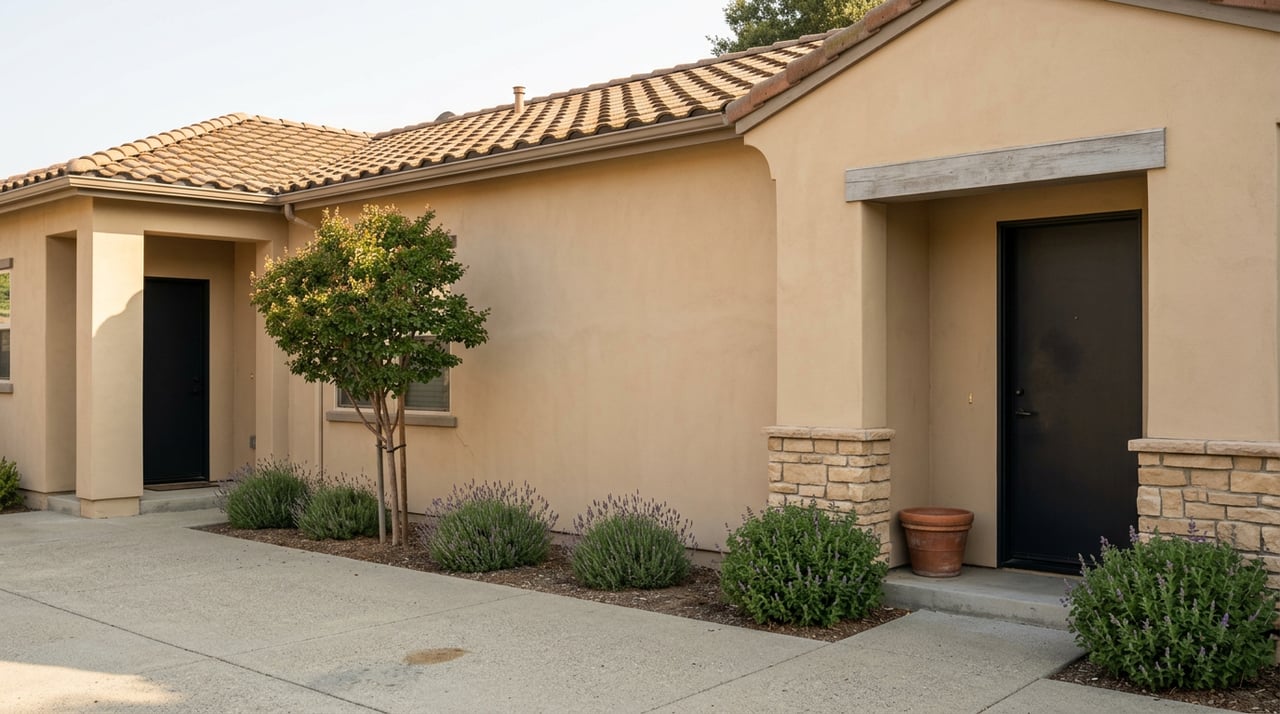
What happens when the Airbnb income you underwrote into your offer doesn't come with the house?
That's the question a growing number of buyers are asking themselves partway through escrow on a Paso Robles duplex, triplex, or small apartment building. The listing photos show a wine country property near downtown. The pro forma assumes nightly rates during Mid-State Fair week and crush season. And then someone calls the Planning Department and learns the short-term rental permit that made the numbers work doesn't automatically transfer to a new owner.
This isn't a rare edge case. It's the structural reality of buying income property in a city that capped non-hosted short-term rental permits years ago and has kept that cap in place ever since.
The Permit That Doesn't Come With The Deed
Paso Robles caps non-hosted short-term rental permits, the kind where a guest rents the entire unit with no owner on site, at 325 citywide, with a hard sub-limit of 75 permits inside the R-1 residential zone. The city's own permit tracking page, with a permit table last updated March 2, 2026, still shows the program at capacity with an active waiting list rather than open applications.
That cap creates a mechanism most buyers don't see coming: the permit is tied to the property's operating history, not guaranteed to the next owner. A city council staff report on the program explains why the R-1 permit count actually fell from 125 permits in 2019 to 89 by November 2023, even though the cap allows up to 75 once it clears. The report attributes the decline largely to permit holders selling their properties, which closes out the short-term rental permit rather than passing it to the buyer. As of that same late-2023 report, 44 applications sat on the R-1 waitlist and another 44 sat on the citywide waitlist, with no guarantee of when or whether a spot would open.
There's one important exception. Homeshare permits, where the owner lives on the property and rents out a room, casita, or accessory unit while present, are not capped at all. The city's short-term rental page states plainly that there is no limit to the number of homeshare permits issued. If your investment plan involves living on site, you're not fighting the waitlist. If it involves buying a standalone rental property and never setting foot in it, you are.
What The Tax Stack Adds On Top
Even for buyers who do land a non-hosted permit, every booking carries a combined tax load of roughly 14.5 percent. Paso Robles voters raised the transient occupancy tax from 10 percent to 11 percent under Measure F-22, effective February 1, 2023. Layered on top are a 2 percent Paso Robles Tourism Improvement District assessment and a 1.5 percent San Luis Obispo County Tourism Marketing District assessment, both charged on the same gross booking revenue.
That tax stack doesn't come out of a host's pocket the way a permit fee does. It's built into what a guest pays. But it does mean nightly rates have to clear a higher bar to stay competitive with hotels and other short-term inventory in the same wine country market, and it adds ongoing tax filing and remittance work that a long-term lease simply doesn't require.
The single most consequential fact for anyone underwriting a Paso Robles income property in 2026 isn't the nightly rate on the listing photos. It's whether the non-hosted permit is even available to you at all.
The Gross Revenue Numbers, And What They Leave Out
Market data from strprofitmap.com puts the median Paso Robles short-term rental host's gross revenue at $53,623 a year, built on a $347 average daily rate and 49 percent occupancy. Top-performing properties clear $80,662 or more.
Compare that to a straightforward long-term lease. RentCafe's rent tracking, updated August 2, 2026, puts the average asking rent for a Paso Robles apartment at $2,641 a month, which works out to roughly $31,700 a year. On paper, the short-term number looks far more attractive.
But the long-term number carries almost none of the overhead the short-term number does. There's no cleaning turnover between every guest, no furnishing and restocking budget, no platform commission, no permit renewal fee, and no exposure to the neighbor complaint provisions the city's ordinance uses as grounds for permit revocation. There's also no waitlist standing between you and the ability to operate at all. The gross revenue gap between the two strategies is real, but it's a gap that only matters if you can legally access the short-term side of it in the first place.
Why The "Median Rent" Number Undersells What A Unit Actually Asks
There's a second gap worth understanding before you underwrite a duplex purchase. Census-reported median gross rent across all occupied Paso Robles units sits around $1,981 a month. That figure blends leases signed at every point over the past several years, including long-tenured tenants paying well under today's asking rates. It's a useful starting point for understanding the broad rental stock, but it isn't what a newly vacant unit will actually command.
RentCafe's current asking-rent average of $2,641 reflects units on the market right now, turned over and repriced to today's demand. The difference between those two figures, roughly $660 a month on a single unit, is the difference between underwriting a duplex off a stale blended average and underwriting it off what you'd actually collect the day a tenant moves out. For a two-unit or four-unit property, that gap compounds fast across a full rent roll.
Where Small Multifamily Actually Fits The Zoning Map
Paso Robles zoning allows multifamily housing by right in several designated districts. The city's own zoning ordinance describes R-2 as the district established for low-scale attached housing, R-3 for medium-density multifamily, and R-4 for medium-high-density multifamily, each implementing a corresponding General Plan residential designation. Additional multifamily geography exists in R-3-O, R-5, and the Uptown and Town Centre Specific Plan areas, though properties inside those specific plan boundaries carry their own separate rules worth verifying before counting on any unit-add potential.
There's also a practical scaling threshold buyers should know: a formal Development Plan review is triggered once a multifamily project reaches 11 or more units on a lot. Below that line, a duplex, triplex, or fourplex acquisition generally moves through a more straightforward path. That threshold is part of why a duplex-to-fourplex trajectory, rather than a jump straight to a larger apartment building, tends to be the realistic entry point for a first small multifamily purchase here.
Before You Write An Offer On A Paso Robles Income Property
- Call the Planning Department directly at 805-237-3970 or email [email protected] to confirm whether any existing non-hosted permit on the property is active, in good standing, and eligible to be reissued to a new owner. Don't rely on what the listing describes.
- If an active permit does exist, ask for the seller's actual booking and tax remittance history rather than a screenshot of projected revenue.
- Underwrite rent using current turnover asking rates for comparable units, not the blended citywide median, since in-place leases can sit well below what a vacant unit will actually command.
- Confirm the parcel's zoning designation, whether it's R-2, R-3, R-3-O, R-4, R-5, or inside the Uptown or Town Centre Specific Plan, before counting on adding units, and keep the 11-unit Development Plan threshold in mind if scaling is part of the plan.
- Check HOA and CC&R restrictions separately from city zoning. Some Paso Robles developments prohibit short-term rentals at the association level even where the city would otherwise permit them.
A Short FAQ
Can I take over the seller's short-term rental permit when I buy a Paso Robles property? Generally, no. City records show that a change in ownership commonly closes out the existing non-hosted permit rather than transferring it, which is part of why the R-1 permit count has drifted down from its 2019 peak even as the waitlist persists.
Is a homeshare permit a workaround? It's a different model entirely, not a loophole. Homeshare permits require the owner to live on the property and are uncapped, but they don't support the whole-unit, owner-absent rental most investors picture when they think "Airbnb."
Is the waitlist still active in 2026? Yes. The city's own permit table, last updated March 2, 2026, continues to show the non-hosted program at capacity.
Does this mean a Paso Robles duplex is a weak investment? Not at all. It means the investment case should be built on long-term rental fundamentals and realistic turnover rents, with any short-term rental upside treated as a bonus you'd need to independently confirm access to, not the baseline assumption in your offer.
If you're weighing a Paso Robles duplex, fourplex, or small apartment building and want the permit status, zoning, and rent numbers checked before you write an offer, that's exactly the kind of groundwork Oaks to Ocean Real Estate handles for buyers every week. Reach out through Jessica Baker's team or request your free home valuation to start the conversation with someone who already knows where the numbers hold up.